Consequently, support surfaces—particularly specialized mattresses for pressure injury prevention—play a far more strategic role than many organizations realize. Beyond simply supporting patient care, they contribute directly to operational efficiency, staff productivity, risk reduction, and overall quality outcomes.
Therefore, for hospitals focused on long-term success, the support surface ecosystem should be viewed as an investment in organizational resilience rather than a routine procurement item. To build a truly sustainable infrastructure, healthcare leaders must transition from a reactive, piecemeal purchasing habit to a comprehensive, systemic evaluation framework that seamlessly bridges clinical indications with long-term economic stability.
Clinical Intent & Acuity Stratification
A resilient support surface strategy begins with objective, evidence-based clinical stratification. Hospitals cannot compromise on patient safety and care quality; asset allocation must precisely map to patient acuity levels and individual risk scores, such as the Braden Scale.
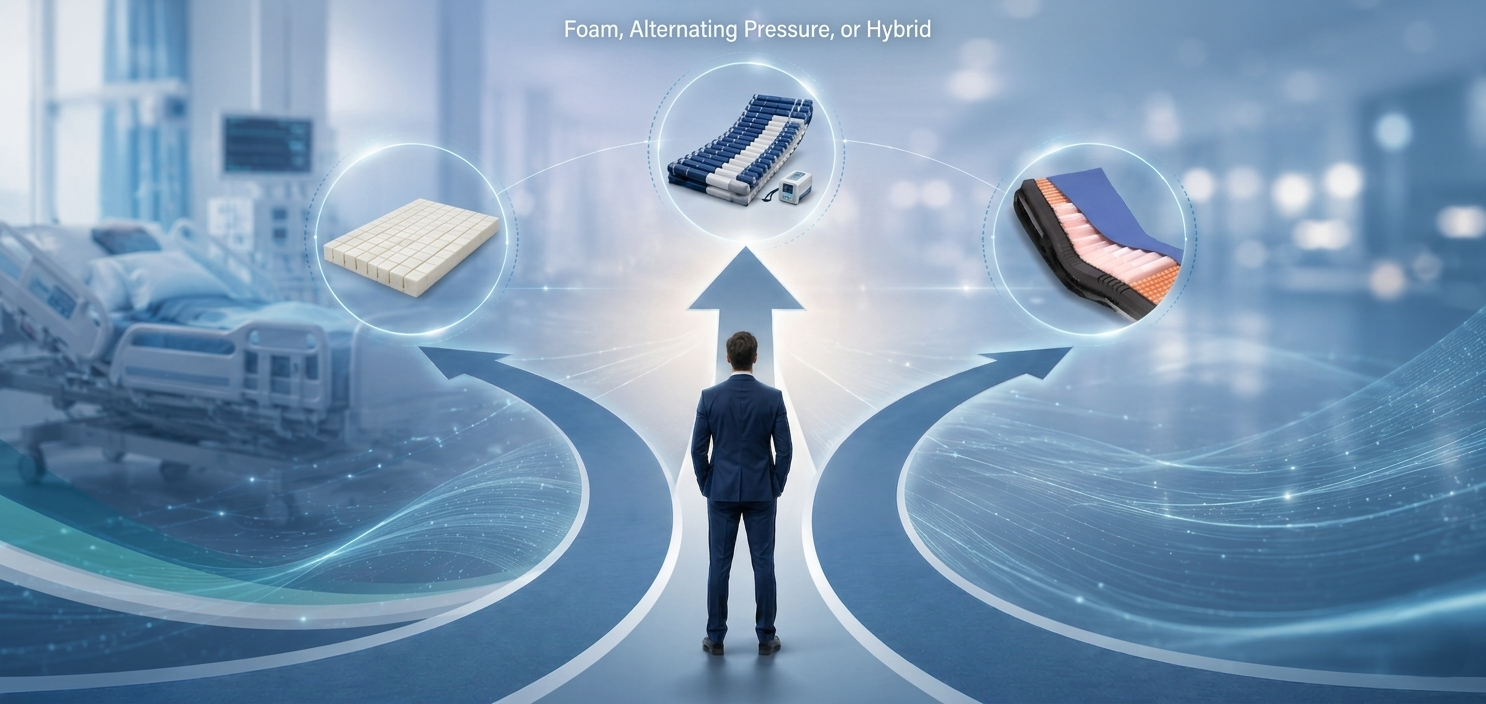
Instead of viewing different mattress technologies as competing options, acute care leadership should deploy them as a multi-tiered clinical defense network.
1. Specialized Foam
Baseline of Standardized CareTo begin with, high-density foam mattresses form the backbone of most hospital standard bed fleets. From a clinical indication perspective, these surfaces are designed for low-risk patients or the early stages of pressure injury (Stage 1-2) who still have preserved mobility.
Crucially, the structural stability of foam provides firm support, making independent movement and repositioning easier for these individuals. In essence, they ensure consistent comfort and basic pressure redistribution for patients who do not present advanced physiological vulnerabilities.
2. Alternating Pressure Systems
Gold Standard for High-Acuity DefenseOn the other end of the spectrum are high-risk individuals—such as those in the Intensive Care Unit (ICU), neurological wards, or critical care units—who suffer from complete immobility and severe hemodynamic instability.
For this demographic, advanced Alternating Pressure (AP) relief systems are clinically considered essential from the onset of risk, including those with early-stage pressure injuries (Stage 1 or 2) up to advanced stages (Stage 3-4) in general wards. By utilizing dynamic, computerized cycle algorithms, they actively relieve pressure and stimulate localized tissue perfusion.
3. Convertible (Hybrid) Systems
The Strategic Agility BufferTo bridge these two extremes, the historical challenge for hospital leadership has been the unpredictable 'grey zone'—patients in sub-acute or general medical-surgical wards whose risk profiles fluctuate unexpectedly due to acute physiological changes. This is where Convertible (Hybrid) systems redefine asset capability.
A convertible surface functions as a premium static foam mattress under normal conditions. However, when a patient’s status deteriorates and they present higher pressure injury risks, it can be instantly converted into a dynamic pressure redistribution surface by connecting an external control unit.
The Operational Benefit of Convertible Design
Clinically, implementing a convertible system eliminates the delays associated with traditional bed management. As a result, it provides a flexible safety valve that accommodates shifting patient acuity in real-time, maintaining clinical continuity without disrupting the patient or the physical care environment.
Hospital Mattress Systems Comparison
| Mattress System | Specialized Foam | Alternating Pressure Relief System | Convertible (Hybrid) |
|---|---|---|---|
| Principle / Working Mechanism | Uses high-density foam to provide basic pressure redistribution and a standardized baseline of care. | Employs a powered pump to inflate/deflate air cells, actively relieving pressure and stimulating tissue perfusion. | Functions as static foam but can be instantly converted to dynamic mode via a powered pump. |
| Use Case / Clinical Indication | Low-risk patients or those with early-stage pressure injury in general wards with preserved mobility and short stays. | Low to High-risk, immobile patients (e.g., ICU) or those with advanced pressure injuries. | Patients with fluctuating risk in sub-acute or med-surg wards, ensuring seamless clinical continuity. |
[Summary: Aligning Clinical Needs with Business Economics]
Having outlined the three main categories of support surfaces available, we must now turn our attention to their strategic application from a business standpoint. From a commercial perspective, the most cost-effective procurement strategy is neither chasing the lowest upfront price nor universally deploying the highest-end equipment; rather, it is fundamentally about "precision resource allocation."
When considering patient care and safety, matching the right mattress to individual clinical needs is critical. But with diverse patient populations sharing the same facility, how can we efficiently allocate our equipment resources to protect everyone while optimizing the bottom line?
In our next section, we will dive into evaluation methods to help you optimize this strategy, ensuring every budget dollar is spent where it matters most.
Discover how precision resource allocation can reduce nursing workflow constraints and maximize equipment ROI in your facility.
Contact a Wellell Specialist [Read More: Dive into our Part-2 article]