
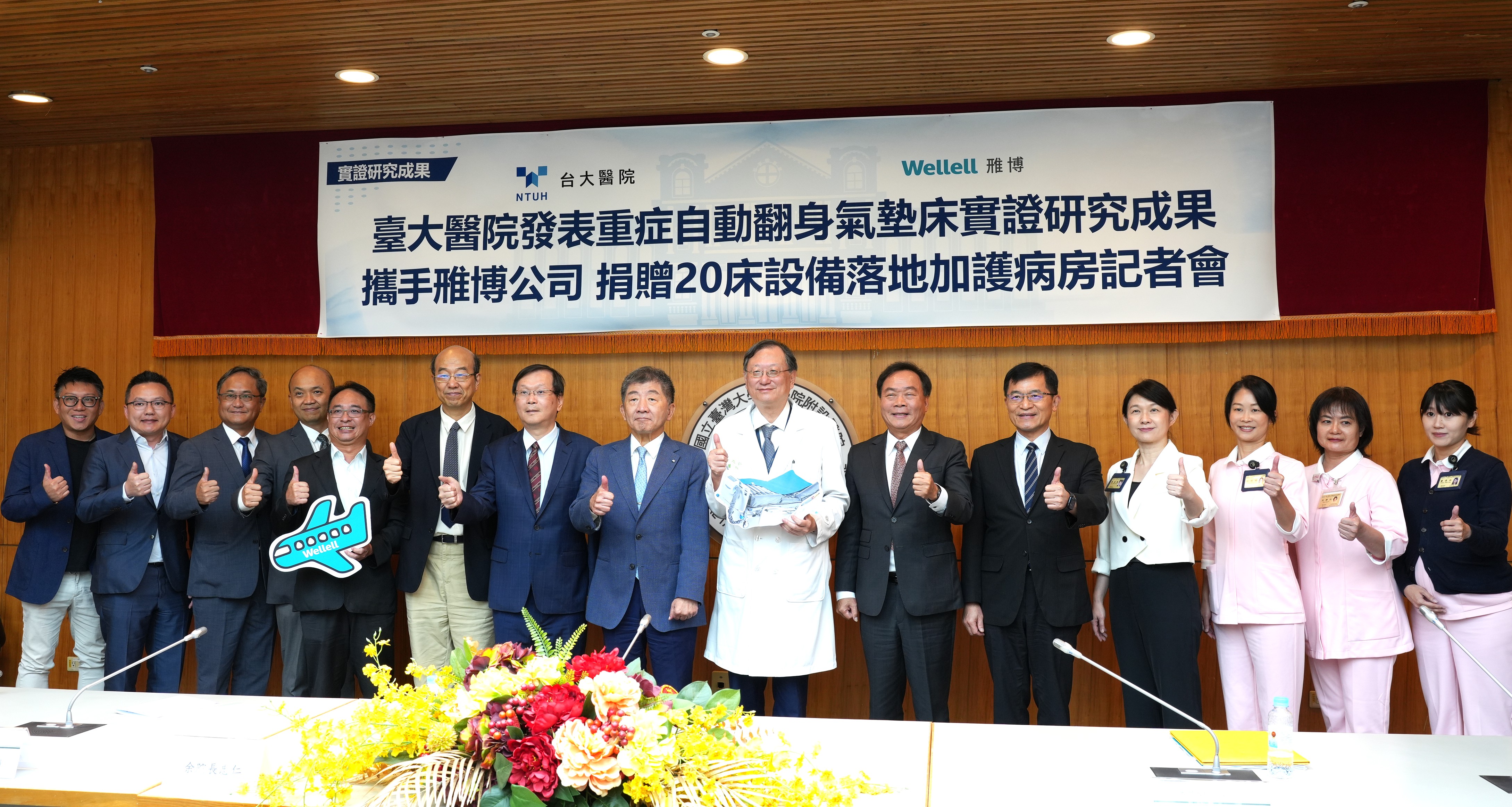
As global healthcare systems face aging populations, rising demand for critical care, and shortages of nursing staff, using technology to improve care processes and ease the burden on frontline caregivers has become a shared challenge worldwide. For Taiwan's smart medical device industry, the next stage of global expansion depends not only on manufacturing and technological innovation, but on the ability to partner with leading medical institutions to build clinical evidence with international credibility.
Wellell Inc. has partnered with National Taiwan University Hospital (NTUH) on a clinical study of automatic turning care in the intensive care unit, combining NTUH's expertise in critical care and clinical research with Wellell's long-standing experience in pressure injury prevention and medical device development. Starting from frontline care needs, the study explores the real-world value of technology-assisted turning in acute and critical care.
From Product Function to Clinical Evidence
Whether a medical device truly succeeds in clinical practice depends not only on its features and specifications, but on whether research can demonstrate its real impact on care processes.
The study was conducted in NTUH's internal medicine and neurosurgery intensive care units, enrolling 424 critically ill patients. Interim results showed that after adopting Wellell's Optima Turn automatic turning system:
- Pressure injury incidence fell from 4.7% to 2.9%
- Nursing workload required for turning decreased by 69%
- Time required per turning procedure was reduced by 53%
- The proportion of turnings that could be completed by a single nurse rose from 36.7% to 91.8%
In terms of clinical acceptance, about 90% of nurses rated their experience with the system positively, and patients also gave positive feedback on comfort and sleep quality. The complete dataset and conclusions will be compiled into a full paper and presented at an international conference following the research review process.
Bringing Taiwan's Clinical Evidence to the World
Clinical evidence and care standards for medical devices have long been led by major medical and research institutions in Europe and the United States. Yet Asia faces similar challenges — rapid population aging, nursing shortages, and rising care demand — and Taiwan's accumulated experience in critical care may offer the world a different path forward.
The results of this study will be compiled according to academic standards and presented at EPUAP (European Pressure Ulcer Advisory Panel) annual conference, an international pressure injury care conference from September 9–11, 2026, where Taiwan's clinical evidence and experience in critical care turning and pressure injury prevention will be shared with experts and scholars from around the world, showcasing the professionalism and strength of Taiwan's healthcare.
On the clinical side, this collaboration highlights the role Taiwanese medical centers play in evidence-based care, nursing research, and medical innovation, and helps raise the international visibility of Taiwan's critical care research. On the industry side, it signals that Taiwan's medical device industry is moving beyond product export alone, toward building an internationally competitive model centered on clinical needs and evidence.
Clinical Capability × Medical Device R&D: A New Model for Healthcare-Industry Collaboration
NTUH brings decades of accumulated expertise in critical care and clinical research; Wellell brings deep experience in pressure injury prevention, patient recovery care, and medical device development. This collaboration began with frontline clinical needs and was validated in a real medical center setting, allowing frontline nursing experience to feed back into product design and care models — forming a cycle in which "clinical needs drive R&D, and R&D outcomes return to the clinic."
Following the completion of this clinical study, Wellell further donated the 20 sets of Optima Turn automatic turning systems used in the study to NTUH, allowing the existing clinical workflow and user experience to continue in the ICU, and laying the foundation for further collaboration on smart care research and clinical innovation between the two parties.
From "Made in Taiwan" to "Proven in Taiwan"
Taiwan has a high-quality healthcare system and comprehensive medical device R&D and manufacturing capabilities. The next stage of international competitiveness for Taiwan's medical device industry depends not only on R&D and manufacturing capability, but on whether clinical evidence can prove that technology truly responds to the needs of caregivers and patients.
This collaboration between NTUH and Wellell is a concrete example of the shift from "Made in Taiwan" to "Proven in Taiwan." By building clinical evidence in a representative healthcare setting and then engaging with the international professional community, what Taiwan exports will no longer be medical products alone, but care experience and clinical value that can withstand scrutiny.
As more medical centers and medical device companies adopt this collaborative model, Taiwan has the opportunity to move beyond its role as a key link in the global medical supply chain, and become a participant and leader in smart care and advanced medical innovation.
Wellell's Strong First-Half Performance
Since 2025, Wellell has been gradually adjusting its operating strategy, with results beginning to show in 2026. Revenue for the first half of the year grew 8% year-over-year, gross margin improved from 46% to 49% over the same period, and earnings per share rose significantly from NT$0.45 to NT$1.09, reflecting a notable improvement in profitability. Consolidated revenue for January through July this year reached NT$1.478 billion, up 7% year-over-year, maintaining continued growth momentum.
This year's growth was primarily driven by strong performance in Europe, the gradual traction of high-end medical air mattresses in hospital channels across the Asia-Pacific region, product mix optimization, and improved operating efficiency — all key factors driving overall performance.